Robustness
Outlier handling through iterative reweighting.
How Robustness Works
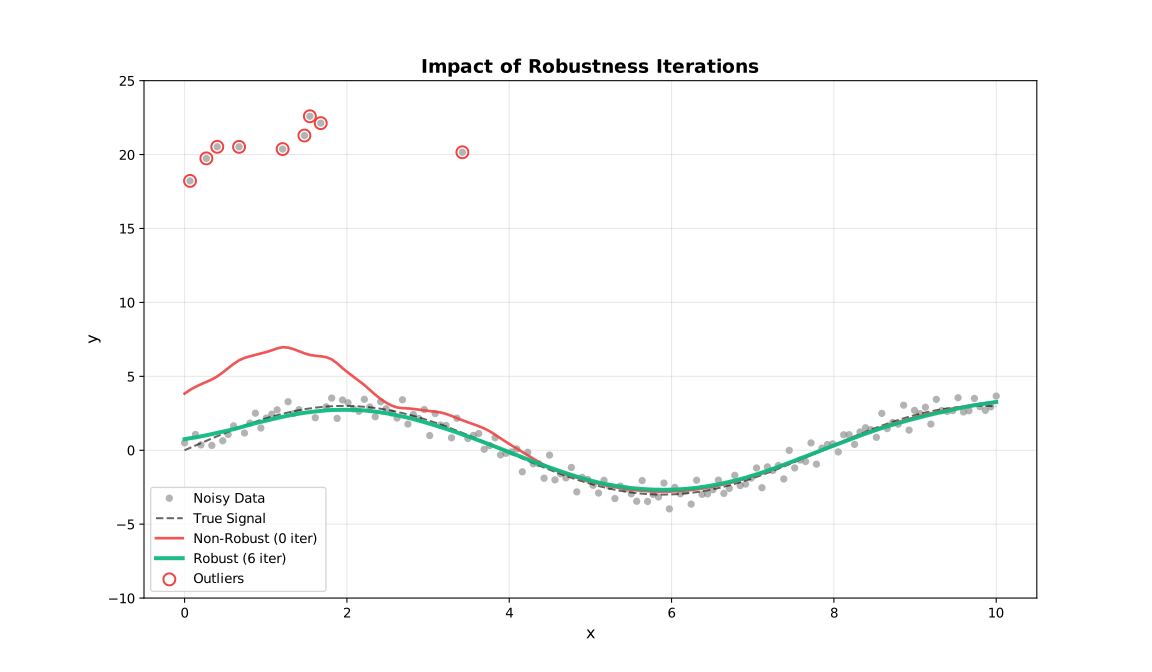
Standard LOESS can be biased by outliers. Robustness iterations downweight points with large residuals:
Fit initial LOESS
Compute residuals
Assign robustness weights (large residuals → low weight)
Refit using combined distance × robustness weights
Repeat steps 2–4
Robustness Methods
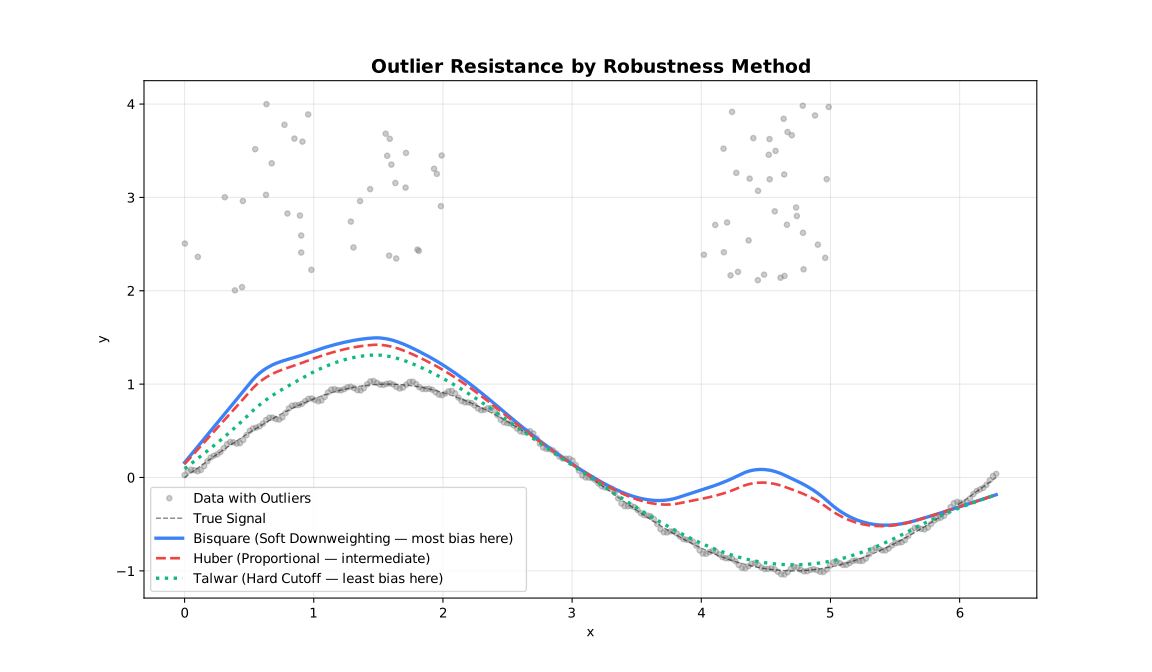
Bisquare (Default)
Smooth downweighting. Points transition gradually from full weight to zero.
\[w(u) = \begin{cases} (1 - u^2)^2 & |u| < 1 \\ 0 & |u| \geq 1 \end{cases}\]
Use when : General purpose, balanced approach.
R Python Rust Julia Node.js WebAssembly C++
model <- Loess ( iterations = 3 , robustness_method = "bisquare" )
result <- model $ fit ( x , y )
model = fl . Loess ( iterations = 3 , robustness_method = "bisquare" )
result = model . fit ( x , y )
let model = Loess :: new ()
. iterations ( 3 )
. robustness_method ( "bisquare" )
. build () ? ;
let result = model . fit ( & x , & y ) ? ;
model = Loess (; iterations = 3 , robustness_method = "bisquare" )
result = fit ( model , x , y )
const model = new Loess ({ iterations : 3 , robustness_method : "bisquare" });
const result = model . fit ( x , y );
const model = new Loess ({ iterations : 3 , robustness_method : "bisquare" });
const result = model . fit ( x , y );
fastloess :: Loess model ({ . iterations = 3 , . robustness_method = "bisquare" });
auto result = model . fit ( x , y ). value ();
Huber
Linear penalty beyond threshold. Less aggressive than Bisquare.
\[w(u) = \begin{cases} 1 & |u| \leq k \\ k/|u| & |u| > k \end{cases}\]
Use when : Moderate outliers, want to retain some influence.
R Python Rust Julia Node.js WebAssembly C++
model <- Loess ( iterations = 3 , robustness_method = "huber" )
result <- model $ fit ( x , y )
model = fl . Loess ( iterations = 3 , robustness_method = "huber" )
result = model . fit ( x , y )
let model = Loess :: new ()
. iterations ( 3 )
. robustness_method ( "huber" )
. build () ? ;
let result = model . fit ( & x , & y ) ? ;
model = Loess (; iterations = 3 , robustness_method = "huber" )
result = fit ( model , x , y )
const model = new Loess ({ iterations : 3 , robustness_method : "huber" });
const result = model . fit ( x , y );
const model = new Loess ({ iterations : 3 , robustness_method : "huber" });
const result = model . fit ( x , y );
fastloess :: Loess model ({ . iterations = 3 , . robustness_method = "huber" });
auto result = model . fit ( x , y ). value ();
Talwar
Hard threshold. Points are either fully weighted or completely excluded.
\[w(u) = \begin{cases} 1 & |u| \leq k \\ 0 & |u| > k \end{cases}\]
Use when : Extreme outliers, want binary exclusion.
R Python Rust Julia Node.js WebAssembly C++
model <- Loess ( iterations = 3 , robustness_method = "talwar" )
result <- model $ fit ( x , y )
model = fl . Loess ( iterations = 3 , robustness_method = "talwar" )
result = model . fit ( x , y )
let model = Loess :: new ()
. iterations ( 3 )
. robustness_method ( "talwar" )
. build () ? ;
let result = model . fit ( & x , & y ) ? ;
model = Loess (; iterations = 3 , robustness_method = "talwar" )
result = fit ( model , x , y )
const model = new Loess ({ iterations : 3 , robustness_method : "talwar" });
const result = model . fit ( x , y );
const model = new Loess ({ iterations : 3 , robustness_method : "talwar" });
const result = model . fit ( x , y );
fastloess :: Loess model ({ . iterations = 3 , . robustness_method = "talwar" });
auto result = model . fit ( x , y ). value ();
Comparison
Method
Transition
Aggressiveness
Use Case
Bisquare Smooth
Moderate
General purpose
Huber Gradual
Mild
Preserve influence
Talwar Hard
Strong
Extreme contamination
Detecting Outliers
Use robustness weights to identify potential outliers:
R Python Rust Julia Node.js WebAssembly C++
model <- Loess ( iterations = 5 , return_robustness_weights = TRUE )
result <- model $ fit ( x , y )
weights <- result $ robustness_weights
outliers <- which ( weights < 0.5 )
cat ( "Potential outliers at indices:" , outliers , "\n" )
model = fl . Loess ( iterations = 5 , return_robustness_weights = True )
result = model . fit ( x , y )
for i , w in enumerate ( result . robustness_weights ):
if w < 0.5 :
print ( f "Potential outlier at index { i } : weight = { w : .3f } " )
let model = Loess :: new ()
. iterations ( 5 )
. return_robustness_weights ()
. build () ? ;
let result = model . fit ( & x , & y ) ? ;
if let Some ( weights ) = & result . robustness_weights {
for ( i , & w ) in weights . iter (). enumerate () {
if w < 0.5 {
println! ( "Potential outlier at index {}: weight = {:.3}" , i , w );
}
}
}
model = Loess (; iterations = 5 , return_robustness_weights = true )
result = fit ( model , x , y )
for ( i , w ) in enumerate ( result . robustness_weights )
if w < 0.5
println ( "Potential outlier at index $i : weight = $w " )
end
end
const model = new Loess ({ iterations : 5 , return_robustness_weights : true });
const result = model . fit ( x , y );
result . robustness_weights . forEach (( w , i ) => {
if ( w < 0.5 ) {
console . log ( `Potential outlier at index ${ i } : weight = ${ w . toFixed ( 3 ) } ` );
}
});
const model = new Loess ({ iterations : 5 , return_robustness_weights : true });
const result = model . fit ( x , y );
result . robustness_weights . forEach (( w , i ) => {
if ( w < 0.5 ) {
console . log ( `Potential outlier at index ${ i } : weight = ${ w . toFixed ( 3 ) } ` );
}
});
fastloess :: Loess model ({ . iterations = 5 , . return_robustness_weights = true });
auto result = model . fit ( x , y ). value ();
auto weights = result . robustness_weights ();
for ( size_t i = 0 ; i < weights . size (); ++ i ) {
if ( weights [ i ] < 0.5 ) {
std :: cout << "Potential outlier at " << i << std :: endl ;
}
}
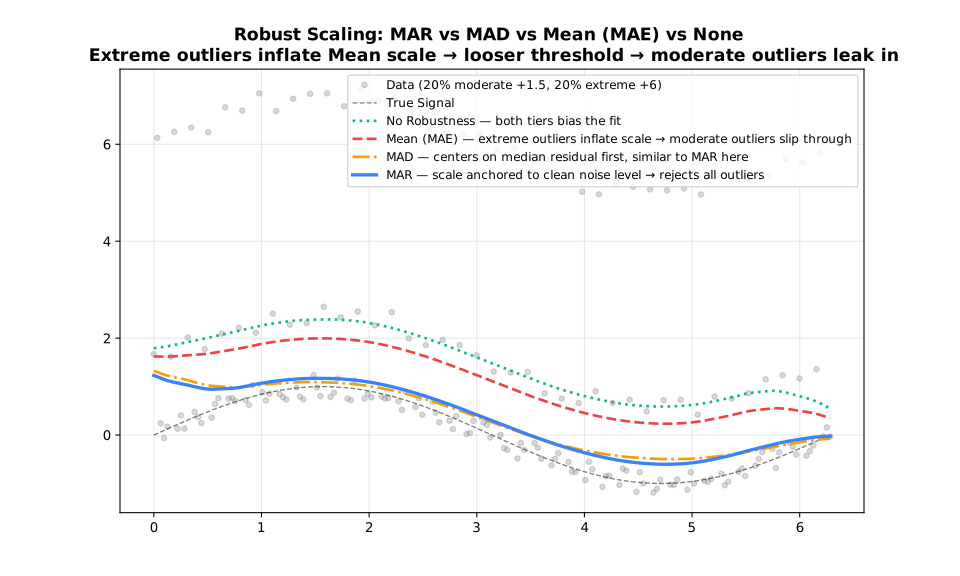
Scale Estimation
Residuals are scaled before computing robustness weights. Two methods:
Method
Formula
Robustness
MAD median(\|r − median(r)\|)Very robust (default)
MAR median(\|r\|)Robust, uncentered
Mean mean(\|r\|)Less robust, fastest
R Python Rust Julia Node.js WebAssembly C++
model <- Loess ( iterations = 3 , scaling_method = "mad" )
result <- model $ fit ( x , y )
model = fl . Loess ( iterations = 3 , scaling_method = "mad" )
result = model . fit ( x , y )
let model = Loess :: new ()
. iterations ( 3 )
. scaling_method ( "mad" ) // Default
. build () ? ;
let result = model . fit ( & x , & y ) ? ;
model = Loess (; iterations = 3 , scaling_method = "mad" )
result = fit ( model , x , y )
const model = new Loess ({ iterations : 3 , scaling_method : "mad" });
const result = model . fit ( x , y );
const model = new Loess ({ iterations : 3 , scaling_method : "mad" });
const result = model . fit ( x , y );
fastloess :: Loess model ({ . iterations = 3 , . scaling_method = "mad" });
auto result = model . fit ( x , y ). value ();
Auto-Convergence
Stop iterations early when weights stabilize:
Performance
Auto-convergence can significantly reduce computation when weights stabilize before reaching max iterations.
R Python Rust Julia Node.js WebAssembly C++
model <- Loess ( iterations = 10 , auto_converge = 1e-6 )
result <- model $ fit ( x , y )
model = fl . Loess ( iterations = 10 , auto_converge = 1e-6 )
result = model . fit ( x , y )
let model = Loess :: new ()
. iterations ( 10 ) // Maximum iterations
. auto_converge ( 1e-6 ) // Stop when change < 1e-6
. build () ? ;
let result = model . fit ( & x , & y ) ? ;
model = Loess (; iterations = 10 , auto_converge = 1e-6 )
result = fit ( model , x , y )
const model = new Loess ({ iterations : 10 , auto_converge : 1e-6 });
const result = model . fit ( x , y );
const model = new Loess ({ iterations : 10 , auto_converge : 1e-6 });
const result = model . fit ( x , y );
fastloess :: Loess model ({ . iterations = 10 , . auto_converge = 1e-6 });
auto result = model . fit ( x , y ). value ();