Intervals
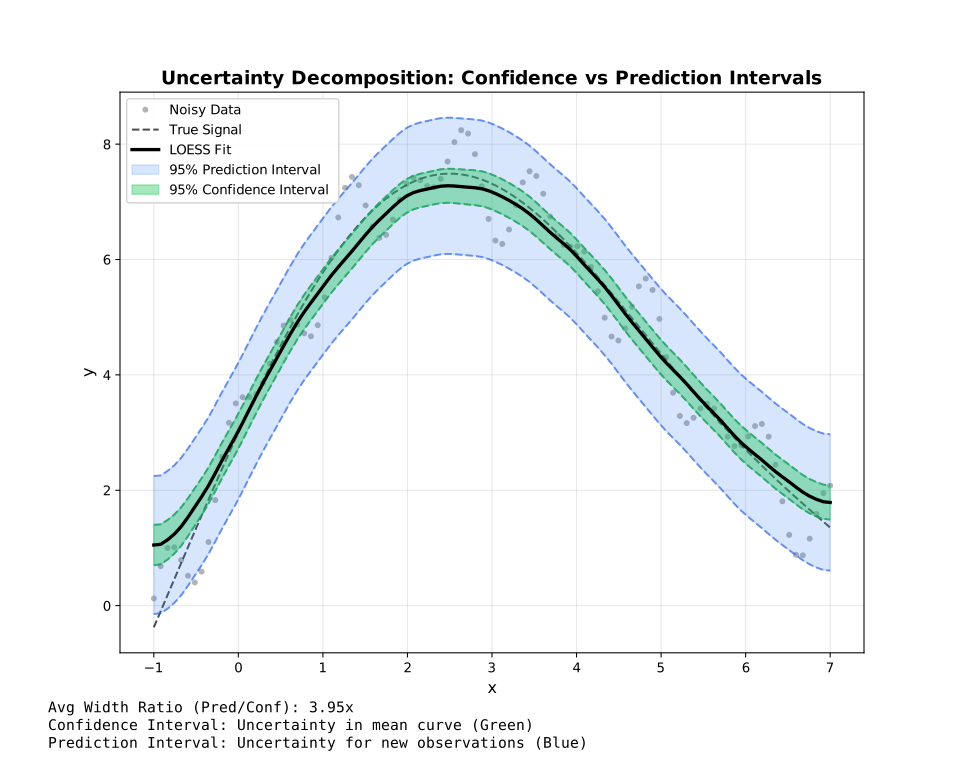
Confidence and prediction intervals for uncertainty quantification.
Overview
Adapter support
Confidence and prediction intervals are available in all three adapters : Batch, Streaming, and Online.
Type
Represents
Width
Use
Confidence Uncertainty in mean curve
Narrow
Where is the true trend?
Prediction Uncertainty for new points
Wide
Where will new data fall?
Confidence Intervals
Estimate uncertainty in the smoothed curve itself.
R Python Rust Julia Node.js WebAssembly C++
model <- Loess ( fraction = 0.5 , confidence_intervals = 0.95 )
result <- model $ fit ( x , y )
# Plot with bands
plot ( x , y , pch = 16 , col = "gray" )
lines ( result $ x , result $ y , col = "blue" , lwd = 2 )
lines ( result $ x , result $ confidence_lower , col = "blue" , lty = 2 )
lines ( result $ x , result $ confidence_upper , col = "blue" , lty = 2 )
model = fl . Loess ( fraction = 0.5 , confidence_intervals = 0.95 )
result = model . fit ( x , y )
print ( "Smoothed:" , result . y )
print ( "CI Lower:" , result . confidence_lower )
print ( "CI Upper:" , result . confidence_upper )
use fastLoess :: prelude :: * ;
let model = Loess :: new ()
. fraction ( 0.5 )
. confidence_intervals ( 0.95 ) // 95% CI
. build () ? ;
let result = model . fit ( & x , & y ) ? ;
// Access intervals
if let ( Some ( lower ), Some ( upper )) = ( & result . confidence_lower , & result . confidence_upper ) {
for i in 0 .. result . y . len () {
println! ( "x={:.2}: y={:.2} [{:.2}, {:.2}]" ,
result . x [ i ], result . y [ i ], lower [ i ], upper [ i ]);
}
}
using FastLOESS
model = Loess (; fraction = 0.5 , confidence_intervals = 0.95 )
result = fit ( model , x , y )
for i in 1 : length ( result . y )
println ( "x= $ ( result . x [ i ]) : y= $ ( result . y [ i ]) [ $ ( result . confidence_lower [ i ]) , $ ( result . confidence_upper [ i ]) ]" )
end
const model = new fl . Loess ({ fraction : 0.5 , confidence_intervals : 0.95 });
const result = model . fit ( x , y );
result . y . forEach (( y , i ) => {
console . log ( `x= ${ result . x [ i ] } : y= ${ y } [ ${ result . confidence_lower [ i ] } , ${ result . confidence_upper [ i ] } ]` );
});
const model = new Loess ({ fraction : 0.5 , confidence_intervals : 0.95 });
const result = model . fit ( x , y );
result . y . forEach (( y , i ) => {
console . log ( `x= ${ result . x [ i ] } : y= ${ y } [ ${ result . confidence_lower [ i ] } , ${ result . confidence_upper [ i ] } ]` );
});
#include "fastloess.hpp"
fastloess :: Loess model ({ . fraction = 0.5 , . confidence_intervals = 0.95 });
auto result = model . fit ( x , y ). value ();
auto ci_lower = result . confidence_lower ();
auto ci_upper = result . confidence_upper ();
Prediction Intervals
Estimate where new observations might fall.
R Python Rust Julia Node.js WebAssembly C++
model <- Loess ( fraction = 0.5 , prediction_intervals = 0.95 )
result <- model $ fit ( x , y )
# Wider than confidence intervals
plot ( x , y , type = "n" )
polygon (
c ( result $ x , rev ( result $ x )),
c ( result $ prediction_lower , rev ( result $ prediction_upper )),
col = rgb ( 1 , 0 , 0 , 0.2 ), border = NA
)
model = fl . Loess ( fraction = 0.5 , prediction_intervals = 0.95 )
result = model . fit ( x , y )
print ( "PI Lower:" , result . prediction_lower )
print ( "PI Upper:" , result . prediction_upper )
let model = Loess :: new ()
. fraction ( 0.5 )
. prediction_intervals ( 0.95 ) // 95% PI
. build () ? ;
let result = model . fit ( & x , & y ) ? ;
if let ( Some ( lower ), Some ( upper )) = ( & result . prediction_lower , & result . prediction_upper ) {
println! ( "Prediction bounds: [{:.2}, {:.2}]" , lower [ 0 ], upper [ 0 ]);
}
model = Loess (; fraction = 0.5 , prediction_intervals = 0.95 )
result = fit ( model , x , y )
println ( "Prediction bounds: [ $ ( result . prediction_lower [ 1 ]) , $ ( result . prediction_upper [ 1 ]) ]" )
const model = new fl . Loess ({ fraction : 0.5 , prediction_intervals : 0.95 });
const result = model . fit ( x , y );
console . log ( `Prediction bounds: [ ${ result . prediction_lower [ 0 ] } , ${ result . prediction_upper [ 0 ] } ]` );
const model = new Loess ({ fraction : 0.5 , prediction_intervals : 0.95 });
const result = model . fit ( x , y );
console . log ( `Prediction bounds: [ ${ result . prediction_lower [ 0 ] } , ${ result . prediction_upper [ 0 ] } ]` );
fastloess :: Loess model ({ . fraction = 0.5 , . prediction_intervals = 0.95 });
auto result = model . fit ( x , y ). value ();
Both Intervals
Request both types simultaneously:
R Python Rust Julia Node.js WebAssembly C++
model <- Loess (
fraction = 0.5 ,
confidence_intervals = 0.95 ,
prediction_intervals = 0.95
)
result <- model $ fit ( x , y )
model = fl . Loess (
fraction = 0.5 ,
confidence_intervals = 0.95 ,
prediction_intervals = 0.95
)
result = model . fit ( x , y )
let model = Loess :: new ()
. fraction ( 0.5 )
. confidence_intervals ( 0.95 )
. prediction_intervals ( 0.95 )
. build () ? ;
let result = model . fit ( & x , & y ) ? ;
model = Loess (;
fraction = 0.5 ,
confidence_intervals = 0.95 ,
prediction_intervals = 0.95
)
result = fit ( model , x , y )
const model = new fl . Loess ({
fraction : 0.5 ,
confidence_intervals : 0.95 ,
prediction_intervals : 0.95
});
const result = model . fit ( x , y );
const model = new Loess ({
fraction : 0.5 ,
confidence_intervals : 0.95 ,
prediction_intervals : 0.95
});
const result = model . fit ( x , y );
fastloess :: Loess model ({ . fraction = 0.5 , . confidence_intervals = 0.95 , . prediction_intervals = 0.95 });
auto result = model . fit ( x , y ). value ();
Confidence Levels
Common levels and their z-values:
Level
z-value
Interpretation
0.90
1.645
90% of intervals contain true value
0.95
1.960
95% of intervals contain true value
0.99
2.576
99% of intervals contain true value
Standard Errors
Access standard errors directly (available when intervals are computed):
R Python Rust Julia Node.js WebAssembly C++
model <- Loess ( confidence_intervals = 0.95 )
result <- model $ fit ( x , y )
print ( result $ standard_errors )
model = fl . Loess ( confidence_intervals = 0.95 )
result = model . fit ( x , y )
print ( "Standard errors:" , result . standard_errors )
let model = Loess :: new ()
. confidence_intervals ( 0.95 )
. build () ? ;
let result = model . fit ( & x , & y ) ? ;
if let Some ( se ) = & result . standard_errors {
for ( i , & se_val ) in se . iter (). enumerate () {
println! ( "Point {}: SE = {:.4}" , i , se_val );
}
}
model = Loess (; confidence_intervals = 0.95 )
result = fit ( model , x , y )
for ( i , se ) in enumerate ( result . standard_errors )
println ( "Point $i : SE = $se " )
end
const model = new fl . Loess ({ confidence_intervals : 0.95 });
const result = model . fit ( x , y );
result . standard_errors . forEach (( se , i ) => {
console . log ( `Point ${ i } : SE = ${ se . toFixed ( 4 ) } ` );
});
const model = new Loess ({ confidence_intervals : 0.95 });
const result = model . fit ( x , y );
result . standard_errors . forEach (( se , i ) => {
console . log ( `Point ${ i } : SE = ${ se . toFixed ( 4 ) } ` );
});
fastloess :: Loess model ({ . confidence_intervals = 0.95 });
auto result = model . fit ( x , y ). value ();
Availability
Batch Mode Only
Confidence and prediction intervals are only available in Batch mode. Streaming and Online modes do not support intervals.
Feature
Batch
Streaming
Online
Confidence intervals
✓
✗
✗
Prediction intervals
✓
✗
✗
Standard errors
✓
✗
✗