Cross-Validation
Automated parameter selection via cross-validation.
Overview
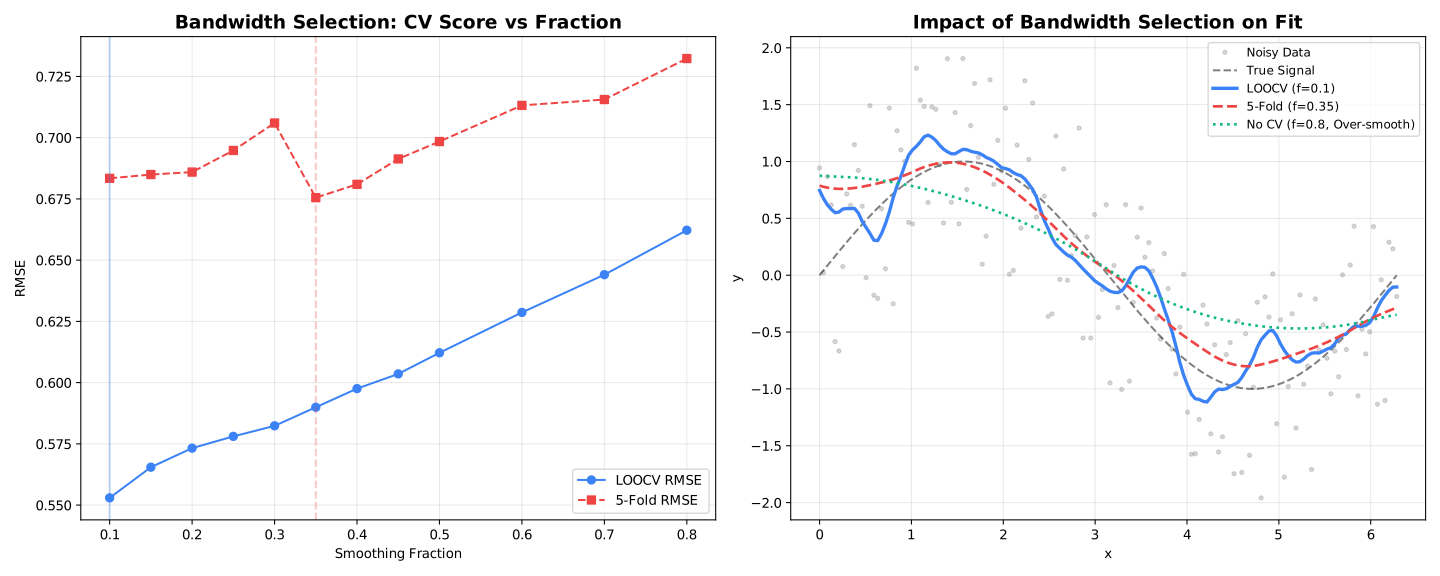
Cross-validation helps select optimal parameters (especially fraction) by evaluating performance on held-out data.
K-Fold Cross-Validation
Split data into K folds, train on K-1, validate on 1.
R Python Rust Julia Node.js WebAssembly C++
model <- Loess (
cv_method = "kfold" ,
cv_k = 5 ,
cv_fractions = c ( 0.2 , 0.3 , 0.5 , 0.7 )
)
result <- model $ fit ( x , y )
cat ( "Selected fraction:" , result $ fraction_used , "\n" )
cat ( "CV scores:" , result $ cv_scores , "\n" )
model = fl . Loess (
cv_method = "kfold" ,
cv_k = 5 ,
cv_fractions = [ 0.2 , 0.3 , 0.5 , 0.7 ]
)
result = model . fit ( x , y )
print ( f "Selected fraction: { result . fraction_used } " )
print ( f "CV scores: { result . cv_scores } " )
use fastLoess :: prelude :: * ;
let model = Loess :: new ()
. cv_method ( "kfold" )
. cv_k ( 5 )
. cv_fractions ( vec! [ 0.2 , 0.3 , 0.5 , 0.7 ])
. build () ? ;
let result = model . fit ( & x , & y ) ? ;
// The best fraction was automatically selected
println! ( "Selected fraction: {}" , result . fraction_used );
if let Some ( cv_scores ) = & result . cv_scores {
println! ( "CV scores: {:?}" , cv_scores );
}
using FastLOESS
model = Loess (;
cv_method = "kfold" ,
cv_k = 5 ,
cv_fractions = [ 0.2 , 0.3 , 0.5 , 0.7 ]
)
result = fit ( model , x , y )
println ( "Selected fraction: " , result . fraction_used )
const model = new Loess ({
cv_method : "kfold" ,
cv_k : 5 ,
cv_fractions : [ 0.2 , 0.3 , 0.5 , 0.7 ]
});
const result = model . fit ( x , y );
console . log ( "Selected fraction:" , result . fraction_used );
console . log ( "CV scores:" , result . cv_scores );
const model = new Loess ({
cv_method : "kfold" ,
cv_k : 5 ,
cv_fractions : [ 0.2 , 0.3 , 0.5 , 0.7 ]
});
const result = model . fit ( x , y );
console . log ( "Selected fraction:" , result . fraction_used );
console . log ( "CV scores:" , result . cv_scores );
#include "fastloess.hpp"
fastloess :: LoessOptions opts ;
opts . cv_fractions = { 0.2 , 0.3 , 0.5 , 0.7 };
opts . cv_method = "kfold" ;
opts . cv_k = 5 ;
fastloess :: Loess model ( opts );
auto result = model . fit ( x , y ). value ();
std :: cout << "Selected fraction: " << result . fraction_used () << std :: endl ;
Leave-One-Out (LOOCV)
Each point is held out once. Most thorough but slowest.
R Python Rust Julia Node.js WebAssembly C++
model <- Loess (
cv_method = "loocv" ,
cv_fractions = c ( 0.2 , 0.3 , 0.5 , 0.7 )
)
result <- model $ fit ( x , y )
model = fl . Loess (
cv_method = "loocv" ,
cv_fractions = [ 0.2 , 0.3 , 0.5 , 0.7 ]
)
result = model . fit ( x , y )
let model = Loess :: new ()
. cv_method ( "loocv" )
. cv_fractions ( vec! [ 0.2 , 0.3 , 0.5 , 0.7 ])
. build () ? ;
let result = model . fit ( & x , & y ) ? ;
model = Loess (;
cv_method = "loocv" ,
cv_fractions = [ 0.2 , 0.3 , 0.5 , 0.7 ]
)
result = fit ( model , x , y )
const model = new Loess ({
cv_method : "loocv" ,
cv_fractions : [ 0.2 , 0.3 , 0.5 , 0.7 ]
});
const result = model . fit ( x , y );
const model = new Loess ({
cv_method : "loocv" ,
cv_fractions : [ 0.2 , 0.3 , 0.5 , 0.7 ]
});
const result = model . fit ( x , y );
#include "fastloess.hpp"
fastloess :: LoessOptions opts ;
opts . cv_method = "loocv" ;
opts . cv_fractions = { 0.2 , 0.3 , 0.5 , 0.7 };
fastloess :: Loess model ( opts );
auto result = model . fit ( x , y ). value ();
Seeded Randomization
Set a seed for reproducible fold assignments:
R Python Rust Julia Node.js WebAssembly C++
model <- Loess (
cv_method = "kfold" ,
cv_k = 5 ,
cv_fractions = c ( 0.3 , 0.5 , 0.7 ),
cv_seed = 42
)
result <- model $ fit ( x , y )
model = fl . Loess (
cv_method = "kfold" ,
cv_k = 5 ,
cv_fractions = [ 0.3 , 0.5 , 0.7 ],
cv_seed = 42
)
result = model . fit ( x , y )
let model = Loess :: new ()
. cv_method ( "kfold" )
. cv_k ( 5 )
. cv_fractions ( vec! [ 0.3 , 0.5 , 0.7 ])
. cv_seed ( 42 )
. build () ? ;
let result = model . fit ( & x , & y ) ? ;
model = Loess (;
cv_method = "kfold" ,
cv_k = 5 ,
cv_fractions = [ 0.3 , 0.5 , 0.7 ],
cv_seed = 42
)
result = fit ( model , x , y )
const model = new Loess ({
cv_method : "kfold" ,
cv_k : 5 ,
cv_fractions : [ 0.3 , 0.5 , 0.7 ],
cv_seed : 42
});
const result = model . fit ( x , y );
const model = new Loess ({
cv_method : "kfold" ,
cv_k : 5 ,
cv_fractions : [ 0.3 , 0.5 , 0.7 ],
cv_seed : 42
});
const result = model . fit ( x , y );
#include "fastloess.hpp"
fastloess :: LoessOptions opts ;
opts . cv_fractions = { 0.3 , 0.5 , 0.7 };
opts . cv_method = "kfold" ;
opts . cv_k = 5 ;
opts . cv_seed = 42 ;
fastloess :: Loess model ( opts );
auto result = model . fit ( x , y ). value ();
Comparison
Method
Folds
Speed
Variance
Bias
KFold(5) 5
Fast
Moderate
Low
KFold(10) 10
Medium
Lower
Lower
LOOCV N
Slow
Lowest
Lowest
Recommendation
Use 5-fold or 10-fold CV for most applications. LOOCV is only worth it for small datasets (N < 100).
CV Metrics
Cross-validation uses MSE (Mean Squared Error) by default:
Lower MSE indicates better fit on held-out data.
Interpreting Results
R Python Rust Julia Node.js WebAssembly C++
# Example output
model <- Loess ( cv_method = "kfold" , cv_k = 5 ,
cv_fractions = c ( 0.1 , 0.3 , 0.5 , 0.7 ))
result <- model $ fit ( x , y )
# Fraction | CV Score (MSE)
# 0.1 | 0.0542 ← Undersmoothed
# 0.3 | 0.0231 ← Best
# 0.5 | 0.0298
# 0.7 | 0.0412 ← Oversmoothed
# Example output
model = fl . Loess ( cv_method = "kfold" , cv_k = 5 ,
cv_fractions = [ 0.1 , 0.3 , 0.5 , 0.7 ])
result = model . fit ( x , y )
# Fraction | CV Score (MSE)
# 0.1 | 0.0542 ← Undersmoothed
# 0.3 | 0.0231 ← Best
# 0.5 | 0.0298
# 0.7 | 0.0412 ← Oversmoothed
// Example output
let model = Loess :: new ()
. cv_method ( "kfold" )
. cv_k ( 5 )
. cv_fractions ( vec! [ 0.1 , 0.3 , 0.5 , 0.7 ])
. build () ? ;
let result = model . fit ( & x , & y ) ? ;
// Fraction | CV Score (MSE)
// 0.1 | 0.0542 ← Undersmoothed
// 0.3 | 0.0231 ← Best
// 0.5 | 0.0298
// 0.7 | 0.0412 ← Oversmoothed
# Example output
model = Loess (; cv_method = "kfold" , cv_k = 5 ,
cv_fractions = [ 0.1 , 0.3 , 0.5 , 0.7 ])
result = fit ( model , x , y )
# Fraction | CV Score (MSE)
# 0.1 | 0.0542 ← Undersmoothed
# 0.3 | 0.0231 ← Best
# 0.5 | 0.0298
# 0.7 | 0.0412 ← Oversmoothed
// Example output
const model = new Loess ({
cv_method : "kfold" ,
cv_k : 5 ,
cv_fractions : [ 0.1 , 0.3 , 0.5 , 0.7 ]
});
const result = model . fit ( x , y );
// Fraction | CV Score (MSE)
// 0.1 | 0.0542 ← Undersmoothed
// 0.3 | 0.0231 ← Best
// 0.5 | 0.0298
// 0.7 | 0.0412 ← Oversmoothed
// Example output
const model = new Loess ({
cv_method : "kfold" ,
cv_k : 5 ,
cv_fractions : [ 0.1 , 0.3 , 0.5 , 0.7 ]
});
const result = model . fit ( x , y );
// Fraction | CV Score (MSE)
// 0.1 | 0.0542 ← Undersmoothed
// 0.3 | 0.0231 ← Best
// 0.5 | 0.0298
// 0.7 | 0.0412 ← Oversmoothed
fastloess :: LoessOptions cv_opts ;
cv_opts . cv_fractions = { 0.1 , 0.3 , 0.5 , 0.7 };
cv_opts . cv_method = "kfold" ;
cv_opts . cv_k = 5 ;
fastloess :: Loess model ( cv_opts );
auto result = model . fit ( x , y ). value ();
// Fraction with lowest CV score is automatically selected.
// 0.1 → 0.0542 ← Undersmoothed
// 0.3 → 0.0231 ← Best
// 0.5 → 0.0298
// 0.7 → 0.0412 ← Oversmoothed
The fraction with lowest CV score is automatically selected.
Availability
Batch Mode Only
Cross-validation is only available in Batch mode.
Feature
Batch
Streaming
Online
K-Fold CV
✓
✗
✗
LOOCV
✓
✗
✗
Best Practices
Test a range : Include fractions from 0.1 to 0.9Use enough folds : 5-10 folds balance speed and accuracySet a seed : For reproducible resultsCheck the curve : CV optimizes MSE, but visual inspection matters